AI vs. Business Process Automation: What’s the Difference, and Why Should You Care?
Something that keeps cropping up more frequently for me in my discussions with customers and partners is a simple but important question: Is it AI, or is it Business Process Automation? Both are driving digital transformation, so why is everything suddenly getting lumped under the 'AI' banner? Let's break it down.
AI is the Brainpower
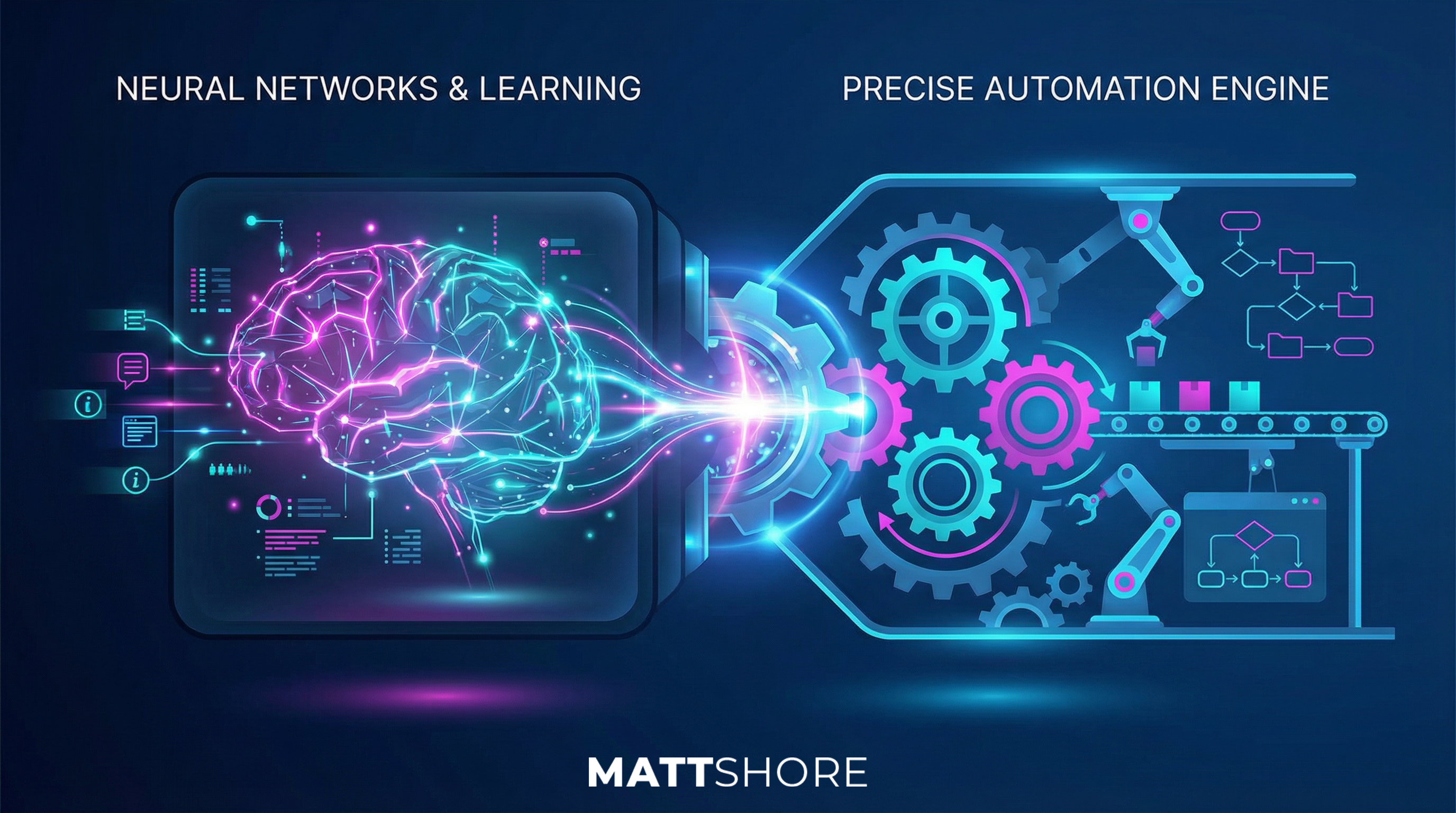
Think of Artificial Intelligence (AI) as the brain of the operation. It’s not about just following a script; it’s about learning, adapting, and making intelligent decisions. AI thrives in complexity and ambiguity, tackling tasks that require reasoning and problem-solving. It finds patterns in messy, unstructured data—like emails, images, or customer feedback—and makes predictions or decisions. It doesn’t just automate; it thinks.
It's the part of the system that can tell you which customers are likely to churn, not just that a customer has churned.
BPA is the Engine of Efficiency
If AI is the brain, then Business Process Automation (BPA) is the powerful, reliable engine. It's all about automating repetitive, rule-based processes with precision and speed. Think of it as the ultimate checklist-follower. From processing invoices and generating reports to sending automated email workflows, BPA is what keeps the core operations running smoothly, consistently, and without error.
BPA doesn't learn or adapt on its own. You give it a set of rules, and it executes them flawlessly, every single time. It's the bedrock of efficiency.
The Power Couple: Where the Magic Happens
The real magic happens when you pair the brain with the engine. When AI and BPA work together, you get a level of automation that's genuinely transformative. The AI handles the complex, messy, and unpredictable parts, and the BPA streamlines the predictable, repetitive tasks that follow.
A classic example: An AI-powered system scans thousands of incoming invoices in various formats (the messy, unstructured data). The AI intelligently categorizes them, extracts the key information (vendor, amount, due date), and even flags anomalies that look like potential fraud (the thinking part). Once the AI has done its job, it hands the structured, verified data over to the BPA engine, which then routes the invoice through a predefined approval workflow, enters it into the accounting system, and schedules the payment (the execution part). Smart, seamless, and efficient.
So, Why Should You Care?
Understanding the difference isn't just about semantics; it's about strategy. Throwing AI at a problem that only needs simple automation is a waste of resources. Trying to solve a complex, data-driven problem with a rigid, rule-based tool will only lead to frustration.
AI transforms how we think. BPA transforms how we work. Knowing which is which allows you to build a smarter, more resilient, and truly innovative business. Together, they're redefining what's possible.